Get Free Ebook On God: An Uncommon Conversation, by Norman Mailer
When you are rushed of task target date and also have no concept to get motivation, On God: An Uncommon Conversation, By Norman Mailer book is one of your options to take. Book On God: An Uncommon Conversation, By Norman Mailer will certainly provide you the ideal resource and thing to get inspirations. It is not just concerning the works for politic business, management, economics, and various other. Some bought jobs to make some fiction works also require motivations to get rid of the work. As what you require, this On God: An Uncommon Conversation, By Norman Mailer will most likely be your option.
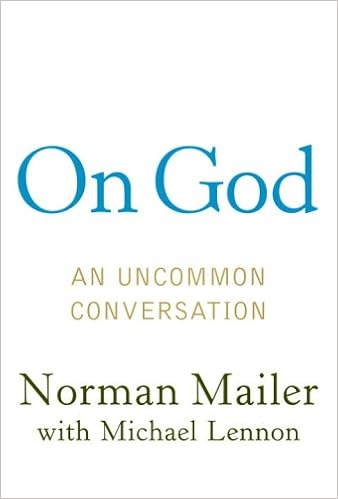
On God: An Uncommon Conversation, by Norman Mailer

Get Free Ebook On God: An Uncommon Conversation, by Norman Mailer
Currently, invite the book vendor that will certainly become the most effective seller publication today. This is it publication. You may not really feel that you are not knowledgeable about this publication, may you? Yeah, almost everyone learns about this publication. It will certainly additionally undertake just how the book is in fact provided. When you could make the chance of guide with the good one, you can pick it based upon the reason as well as reference of how guide will be.
Guides that exist originated from many libraries in the world. It implies that you will find the hundreds publications from many authors and also authors from the globe. We realize that such individuals will require the book from various other country. If they have to spend much cash to order and also await many times, you could get various ways right here. Here, you could quickly obtain the most convenient method to connect to the book as On God: An Uncommon Conversation, By Norman Mailer directly.
The existence of On God: An Uncommon Conversation, By Norman Mailer in product listings of analysis can be a new manner in which supplies you the excellent analysis product. This source is likewise sufficient to review by anybody. It will not compel you to find with something strong or dull. You can take better lesson to be in an excellent way. This is not type of huge book that comes with difficult languages. This is an easy book that you can worry about. So, exactly how vital the book to read is.
Various other reasons are that this publication is written by a motivating author that has professionalism to write as well as make a publication. Nonetheless, the product is easy however significant. It does not make use of the tough and challenging words to understand. The web content that is provided is truly significant. You could take some impressive factors of reviewing On God: An Uncommon Conversation, By Norman Mailer when you have begun reading his book sensibly.
Review
“[Displays] the glory of an original mind in full provocation.”–USA Today“[Mailer’s] theology is not theoretical to him. After eight decades, it is what he believes. He expects no adherents, and does not profess to be a prophet, but he has worked to forge his beliefs into a coherent catechism.”–New York“At once illuminating and exciting . . . a chance to see Mailer’s intellect as well as his lively conversational style of speech.”–American Jewish LifeFrom the Trade Paperback edition.
Read more
About the Author
Norman Mailer was born in 1923 in Long Branch, New Jersey, and grew up in Brooklyn, New York. In 1955, he was one of the co-founders of The Village Voice. He is the author of more than thirty books, including The Naked and the Dead; The Armies of the Night, for which he won a National Book Award and the Pulitzer Prize; The Executioner’s Song, for which he won his second Pulitzer Prize; Harlot’s Ghost; Oswald’s Tale; The Gospel According to the Son; and The Castle in the Forest. Mr. Mailer passed away Saturday November 10th, 2007.
Read more
See all Editorial Reviews
Product details
Hardcover: 240 pages
Publisher: Random House; First Edition edition (October 16, 2007)
Language: English
ISBN-10: 1400067324
ISBN-13: 978-1400067329
Product Dimensions:
5.9 x 1 x 8.5 inches
Shipping Weight: 15.5 ounces (View shipping rates and policies)
Average Customer Review:
4.2 out of 5 stars
24 customer reviews
Amazon Best Sellers Rank:
#1,230,764 in Books (See Top 100 in Books)
It's been a while since I read this book, and haven't finished it yet. But, based on what I read I would say this, that his topics are very interesting, but his conversational style leaves the topics dealt with in a very narrow manner, sometimes somewhat unnervingly so. Anyone who was so inclined could probably sit down with a notebook and add their own thoughts to the helpfully laid out sections, and wind up with a book two or three times the size of the original. If I were a teacher, and this was a term paper, I would hand it back and say 'there was a lot of good material in here, now finish it and put it all together.'-perhaps he was clever in this.-He assumes that there is definitely a God even if this is not the God someone told him about, exactly.-He brings a lot of ideas to the table that we probably wouldn't think of our own.-He sticks his neck out and says 'I believe this or that.' and assuming he's not that bad, makes it seem more OK to at least discuss these things.I think these are very commendable, given the seriousness of the topic, and am grateful he provides so much food for thought and fuel for discussion.
I found this book to be interesting in that it provided a very personal exposure to another's spiritual reasoning. As major criticism I offer that Mr. Mailer's vision is unconsciously Judeo-Christian, and does not rebel enough against conventional stereotypes, or should I say, images, of what might constitute God. God does not have to be outside the world that is created, and may not be the anthropomorphic figure that Mailer is fixated on. The intelligence of matter may very well be internal, in a more pantheistic sense, and what Mailer heroically portrays as God versus the Devil may well be simply our emotional human conception of the yin-yang of good vs. evil. I prefer the image of Shakti, who with one hand creates and the other destroys, without regard to the feelings of creatures affected. I cannot assume with Mr. Mailer that our personal egos are of vital concern to some all knowing deity, who is plotting out our individual destinies as part of his overall plan to build a better world.
This book (Mailer's last) is very important. It gives a stunning perspective on what happens when you believe in a higher power. I do not typically read books on the subject of God, but somehow I was drawn to this book and ended up finding it very enlightening.
Mailer's God is one that he can picture, and in the author's mind humankind was created in God's image. Thus far his belief jibes with the "Judeo-Christian enterprise"; not so with Islam where Allah is immaterial and invisible and, therefore, hard to imagine. Mailer takes a decidedly Christian tack, however, in his regard for the divine nature of Jesus, seeing no reason why God wouldn't express himself in human form. But this is about as conventional he will get in the course of these interviews, and it is his more unorthodox opinions that make On God an engaging book.Life, according to Mailer, is a tripartite struggle involving God, the Devil and Human Being. Sometimes God has the upper hand, sometimes the Devil. As the two are often present, men and women of all persuasions act upon their influences. We face tough choices given Mailer's claim that technology and fundamentalism are instruments of the Devil. Never mind the latter, but how does one avoid the "subtle, insidious abuses" of the former?While the book is undeniably thought-provoking, it nonetheless struck me as a facile explication of religion's more untenable positions on the origin of life and the hereafter. For example, Mailer's idea of reincarnation as the "nexus of judgment" treats life as a sporting event. A person that was more bad than good might come back crawling on six legs. It's up to God to determine who becomes what. You're either back in the game, in the penalty box, or banned for life (not everyone gets reincarnated).Although interesting, Mailer's theology is no less anthropomorphic than Christianity. His God has the mannerism of Homo sapiens. He is an artist who like all creators is imperfect and existential, has evolved with the plants and animals, is not immortal and has no need for glorification. Mailer rejects the all-good, all-powerful notion of God, calling it oxymoronic. God cannot be both.Mailer is most convincing on the matter of technology, which "could be a third force, ready to destroy both God and the Devil--man's assertion against God and the Devil." Could it be that organized religion has run its course? Are we in the process of shucking monotheism for something else? Technology, and for Mailer it comes down to electronics, seems to have dampened our faith in God and respect for religious institutions. Our distractedness has the effect of warding off divine influence. Having lost touch, we care less. And in Mailer's scheme, God may care less too.
I finished this book last night - the only Mailer I'd attempted before was Ancient Evenings, which I couldn't bear to plow through. I was raised a Roman Catholic but having attended Protestant-affiliated schools, I have always felt some distance from the Church.By reputation, I knew that Mailer was brilliant, and that opinions about him were strong. I bought the book as I was curious and interested to see what he had to say about God given his intellectual perch. The book is in the form of a dialogue, and Mailer's answers at times seem to ramble. At the end however, I felt that I had a good sense of his own brand of theology that essentially, God the creator, is a not all-powerful artist.The book is a fascinating discussion of the relations amongst God, the Devil, and man; how Mailer feels that reincarnation works; how the creation by the artist meshes with evolutionary theory; and ultimately, the overarching value of compassion and what should be man's goal in life, which is to make the best of one's God-given talents, and not be selfish down to minutiae in going about it.When Mailer declares that he believes animals have souls, I knew that I had to keep reading, for my son's Roman Catholic religious education teacher told him that animals do not have souls, and he came home deeply upset.Ultimately, Mailer works from the God as artist premise, and his argument is not illogical, but a far cry from what the Roman Catholic church (at the very least) is preaching.
Mailer makes his case in compelling ways, challenging and thought provoking. Highly recommended.
On God: An Uncommon Conversation, by Norman Mailer PDF
On God: An Uncommon Conversation, by Norman Mailer EPub
On God: An Uncommon Conversation, by Norman Mailer Doc
On God: An Uncommon Conversation, by Norman Mailer iBooks
On God: An Uncommon Conversation, by Norman Mailer rtf
On God: An Uncommon Conversation, by Norman Mailer Mobipocket
On God: An Uncommon Conversation, by Norman Mailer Kindle



0 komentar:
Posting Komentar